


Each year, the U.S. Supreme Court receives thousands of petitions asking the justices to hear a case. Only a small percentage are granted. For Ava Jerro, the question of why some petitions succeeds while others do not become the foundation for an ambitious research project.
Each year, the U.S. Supreme Court receives thousands of petitions asking the justices to hear a case. Only a small percentage are granted. For Ava Jerro, the question of why some petitions succeeds while others do not become the foundation for an ambitious research project.
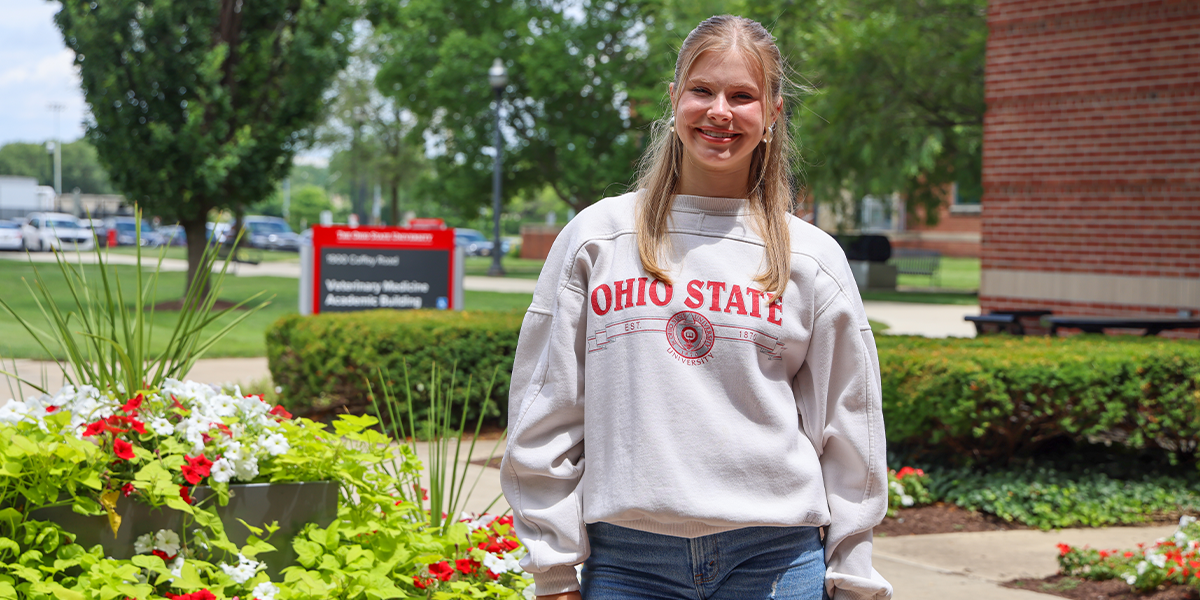
A participant in Ohio State’s Undergraduate Research Apprenticeship Program (URAP) working with project mentor Dr. Janet Box-Steffensmeier, Jerro is exploring what separates the small number of petitions the U.S. Supreme Court agrees to hear from the thousands it declines each year.
“My research asks whether the quality of legal writing shapes which cases the U.S. Supreme Court agrees to hear,” Jerro said.
Working in the American Institutions and Methodology Lab, Jerro combines quantitative and qualitative research methods to better understand what makes a certiorari petition persuasive. She evaluates a large collection of legal briefs across five dimensions of writing quality: engagement, conciseness, flow, crispness and clarity and analyzes whether those characteristics are associated with the Court’s decision to grant review.
At the same time, she has interviewed elite Supreme Court advocates, federal judges and former law clerks to gain insight into how legal professionals approach the process of crafting effective petitions.
The findings suggest that strong writing is important, but not necessarily in the way many might expect.
“Together, these reveal that clean sentence-level mechanics set a baseline, but the real differentiator is strategy,” Jerro said. “It’s how advocates frame the question presented and build their arguments.”
For Jerro, the project reflects what she enjoys most about research: the opportunity to explore questions that do not yet have clear answers.
“What I like most is that research lets me chase a question no one has fully answered yet,” she said. “This project sits right at the intersection of philosophy, politics and economics, it looks like a legal and empirical question, but it’s really about persuasion and judgment.”
Through the project, she has gained experience conducting interviews, analyzing data and developing an argument from a complex set of observations.
“I've gotten to interview Supreme Court advocates and federal judges, work through data, and watch a messy set of observations slowly become a coherent argument,” Jerro said.
Her research experience has also shaped how she thinks about the process of scholarly inquiry. She says one of the most important lessons she has learned is that successful research begins with asking the right questions.
“I've learned that good research is as much about asking the right question as answering it,” she said. “A strong project usually means narrowing an ambitious idea into something you can actually measure.”
The project has already earned national recognition, having been accepted for presentation at the American Political Science Association Annual Meeting.
Looking ahead, Jerro hopes to continue refining her ability to communicate research findings to broader audiences and carry the work forward into a future thesis.