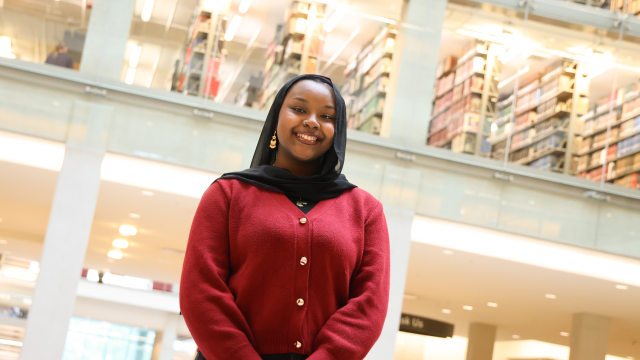
When Daranii Asoba began exploring the relationship between women’s rights and U.S. foreign policy in Afghanistan, she found herself drawn to questions that are often overlooked in discussions about war and military intervention.
A senior majoring in Public Management, Leadership, and Policy with a minor in Inequality and Society, Asoba is participating in Ohio State’s Undergraduate Research Apprenticeship Program (URAP) under the mentorship of Mehr Mumtaz. Her research explores how narratives surrounding Afghan women’s rights became intertwined with U.S. foreign policy and political support for military intervention following the Sept. 11, 2001, terrorist attacks.
Her work draws on transnational feminist framework to examine how U.S. political rhetoric deployed gendered narratives—particularly tropes of women’s rights and gender inequality in Afghanistan—to justify both the two-decade long military intervention and its eventual withdrawal in 2021.
“I focus on the inherent tension between the promise of ‘liberating’ Afghan women and the military and political goals of the intervention,” Asoba said.
Through content analysis of U.S. congressional hearings and Congressional Research Services (CRS) reports, Asoba traces the continuity and change in the U.S.’s discursive strategies across two decades, asking how “saving Afghan women” functioned as political justification at moments of military escalation and disengagement. Ultimately, her project tries to interrogate the relationship between gendered humanitarian discourse and U.S. foreign policy legitimation.
For Asoba, the project reflects a larger interest in understanding complex social and political issues from multiple perspectives. She says one of the most rewarding aspects of research is the opportunity to challenge assumptions and uncover deeper layers of a story.
“I like that research allows me to look beyond common explanations and understand an issue from critical perspectives,” Asoba said. “I especially enjoy finding connections between history, politics, media and people’s lived experiences.”
That interdisciplinary approach has shaped how she thinks about both the research process and the topic itself. As she examines the narratives that emerged after 9/11, she is learning to ask critical questions about who tells stories, whose experiences are elevated and whose voices are left out of public conversations.
“Research has also helped me question common narratives and consider whose voices are being included or left out,” she said. “Especially with my research question, I am able to question the common narratives that were pushed by media and government after 9/11.”
Participating in URAP has also strengthened Asoba’s understanding of what it means to conduct rigorous scholarship. She says the experience has reinforced the importance of intellectual curiosity, critical analysis, and openness to new perspectives.
“I've learned that strong research requires more than finding sources that support what I already believe,” Asoba said. “It requires comparing different arguments, evaluating the credibility of sources and remaining open to conclusions I may not have expected.”
As her research continues, Asoba hopes to further develop tools for studying issues that affect marginalized communities and to ensure that those most impacted by policies and conflicts remain at the center of the conversation.
“I hope to continue learning how to center the voices and/or perspectives of the people most directly affected by the issues I study,” she said.
By examining the intersections between gender, media and international politics, Asoba’s work highlights the value of undergraduate research in tackling difficult questions that have grave consequences for political (re)thinking. Her project not only explores a pivotal moment in recent history but also encourages a deeper examination of how narratives shape public understanding and why it is important to listen to the voices that are left invisible.